What Evaluators Actually Skip Past
Here is something most recruits never hear. When a scout opens your film link, the clock starts at about four seconds. Not four minutes. Four seconds. If nothing in that window tells him what he needs to know, he closes the tab and opens the next one in a stack of two hundred.
So the question is not "how do I make my mixtape look cool." The question is "what does this person need to see to believe I can play at his level." Those are two completely different jobs. Most players spend their money and their weekends on the first one.
Six Things That Get Fast-Forwarded Every Time
Sit next to a college assistant while he grinds film and you notice something odd. He barely watches the ball. He watches feet, hips, hands, and the two seconds before contact. Then he scrubs forward.
Here is what gets skipped almost every time:
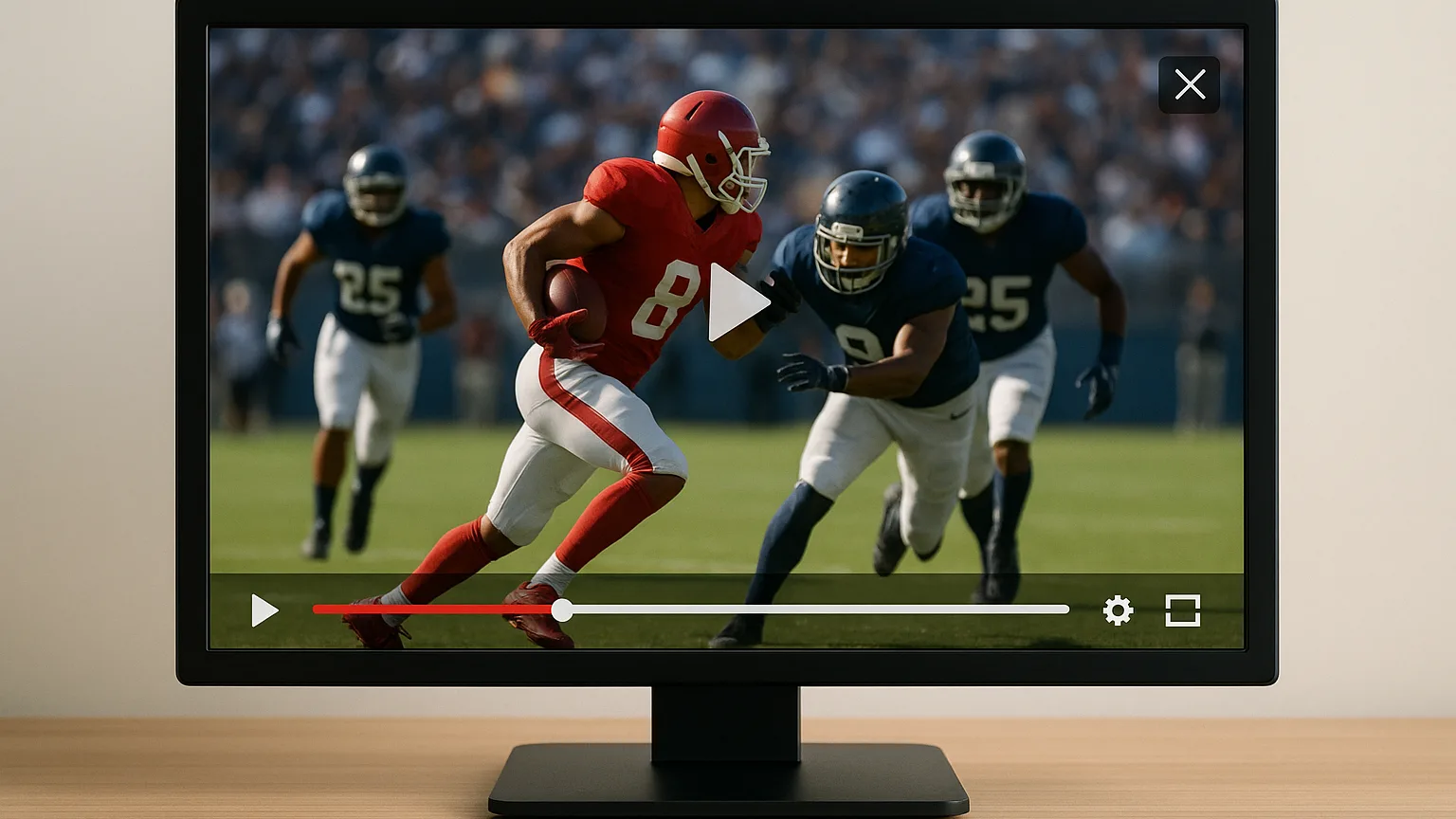
- Intro graphics. Your name in flaming letters with a bass drop. Nobody has ever offered a scholarship because of a title card. Cut it.
- Music. Most evaluators mute it anyway. Worse, loud music often means you also cut the audio cues that tell a scout when the ball was snapped.
- Slow motion. Slow motion hides feet. If you slow down your best play, an experienced eye assumes you are hiding something in the speed.
- Spotlight circles that follow you. Fine for the first three clips. After that a scout wants to see whether he can find you himself, because that is exactly what he does on real film.
- Plays against clearly overmatched opponents. A 60 yard run against a team that finished 0-10 tells him nothing except that you can run past bad players.
- Anything where the play is over before the camera focuses. Sideline phone video, zoomed in, shaky. Unusable.
The pattern is simple. Scouts skip anything that removes context. A mixtape is built to remove context on purpose. That is why it works on social media and fails in an evaluation room.
The Trust Problem Nobody Talks About
A 90 second reel of your 12 best plays from a 10 game season is, statistically, about 1 percent of your snaps. Every evaluator knows this. So the reel raises a question instead of answering one: what happened on the other 99 percent?
When you send full games, you answer that question before it gets asked. You are saying, in effect, watch me get beat and then watch what I do next. That single move separates you from thousands of players who only show their wins. Coaches talk about it. I have heard college staffers say a full-game link is the fastest credibility signal a high school kid can send.
Steve Reilly, a longtime junior college defensive coordinator, put it bluntly to a room of recruits: "Show me your worst quarter. If you played hard in it, I am interested."
The Four Layers Of A Package Coaches Open
Full games do not mean dumping three raw two hour videos in a message and hoping. That gets ignored just as fast as a mixtape, only for a different reason. Nobody has two hours for a player they have never heard of.
The package that works has layers. Each layer buys you the next one.
Layer One: The Thirty Second Front Door
Not a highlight reel. A verification clip. Three to five plays, no edits, no music, that prove your one clearest physical trait. If you are a corner with real speed, show three plays where you run with somebody. If you are a guard who can pull, show three pulls. One trait, shown plainly, at full speed, from a wide angle where a scout can see all 22.
Label it exactly like this: Name, Position, Height, Weight, Class Year, School, Jersey Number, Which Side Of The Formation. That last one saves an evaluator ten seconds per clip, and ten seconds is a lot when you are the twelfth link he opened before lunch.
Layer Two: Two Full Games, One Good, One Rough
Pick your best complete performance and your hardest matchup of the season. Yes, the hard one. Timestamp your snaps in the description so a scout can jump in wherever he wants. Do not trim the bad drives. Do not cut the play where you got pancaked.
This is where recruits get nervous, and it is the exact spot where the smart ones separate. A scout who watches you struggle against a good player and sees you finish the game the same way you started it now has real information. He can project you. He cannot project a guy from a highlight reel.
Layer Three: Position Specific Cutups
These are the technique clips, and they are what earn a second viewing. More on those in a minute, because this is the part almost nobody sends.
Layer Four: The Boring Stuff That Closes Deals
- Verified height and weight, measured recently, not what you told people freshman year
- GPA, core GPA if you know it, and test scores if you have them
- Your high school or JUCO coach's cell number and permission to use it
- Track times or lift numbers with the date and where they were recorded
- Any transcript or eligibility notes, which matter enormously once ask these 12 questions before enters the picture
None of that is glamorous. All of it decides whether a coach can actually recruit you or has to move on because your paperwork is a mystery.

The Reps That Get You A Phone Call
Every position has two or three moments that a coach uses as a shortcut for coachability. These are rarely the plays that get views online. They are the plays that get a phone call.
By Position
- Offensive line: A rep where you get beat inside, recover with your feet, and keep the defender off the quarterback anyway. Also any snap where you come off a combo block and pick up a linebacker in space.
- Defensive line: Hand usage against a good tackle. A rip, a swipe, a counter after your first move failed. Scouts want to see a second move exist at all.
- Linebacker: A play where you read run, step, then diagnose pass and redirect. Diagnosis speed is the whole position.
- Cornerback: A rep where you get turned around and still find the ball. And a tackle in the open field on a bigger player.
- Safety: Communication. Point at people. Move somebody. If the camera catches you rotating the back end before the snap, that clip is worth more than an interception.
- Quarterback: Full progression reads with a wide angle. Third down conversions where the first look was covered. Also a bad throw followed by the next throw.
- Running back: Pass protection reps. Nothing else moves a college coach faster, because it decides whether you play as a freshman.
- Receiver: A contested catch, a route against press, and a downfield block that actually finishes.
- Specialists: Uncut, single camera, from behind, with the ball flight visible and the distance stated on screen.
Effort Clips Are Not A Cliche
Coaches genuinely hunt for these, and they are cheap to produce because you already made the plays. Look for snaps where you are 25 yards from the ball and still sprinting. A tackle at the end of a long return. A downfield block on a screen that gained 40 yards. A pursuit angle from the back side.
Three clips like that tell a staff you will play special teams, and special teams is how most recruited freshmen actually see the field. It is also how a lot of overlooked prospects end up on rosters at levels nobody predicted, the same way front offices find starters nobody tends to happen in the pro ranks.
Small Things That Make Film Watchable
- Wide angle, elevated if possible. Sideline level video is nearly worthless for evaluating anybody but a ball carrier.
- Two to three seconds before the snap so a scout sees alignment and any motion.
- Let the play finish. Cutting at the catch hides the finish, and the finish is the evaluation.
- One link, one platform, mobile friendly. If it needs a login, it does not get watched.
- Update the same link instead of sending five new ones. Coaches keep notes on links.
Send The Truth, Not The Trailer
The mixtape era trained a generation of players to sell a highlight when the market was buying a projection. Those are opposite products. A highlight says "look what I did once." A full game says "here is who I am for three hours against a real opponent, including the reps I lost." Only one of those helps a coach decide whether to spend a roster spot, a scholarship, and two years of development on a stranger.
So build the layered package. Thirty seconds of plain verification, two complete games including the ugly one, position specific technique cutups, effort clips, and the unglamorous paperwork that makes you recruitable. Then stop editing and start sending, early in the week, with your number and your coach's number attached. The prospects who get found are almost never the ones with the best music. They are the ones who made it easy to be believed.