Depth Chart Math That Actually Matters
Every recruiting pitch sounds good in a living room. There is a coach on the couch, a hat on the table, and a parent trying to figure out if any of it is real. The pitch is not the problem. The problem is that most families ask questions that are easy to answer well.
"Do you see me playing early?" gets a yes. "Is this a family?" gets a yes. "Do you develop guys?" gets a highlight reel. None of those answers tell you anything, because no coach on earth answers them badly.
The questions below are different. They are specific enough that a vague answer stands out. Each one comes with the response that should make you pause, take notes, and call two more schools before you say yes to anything.
Count The Bodies Ahead Of You
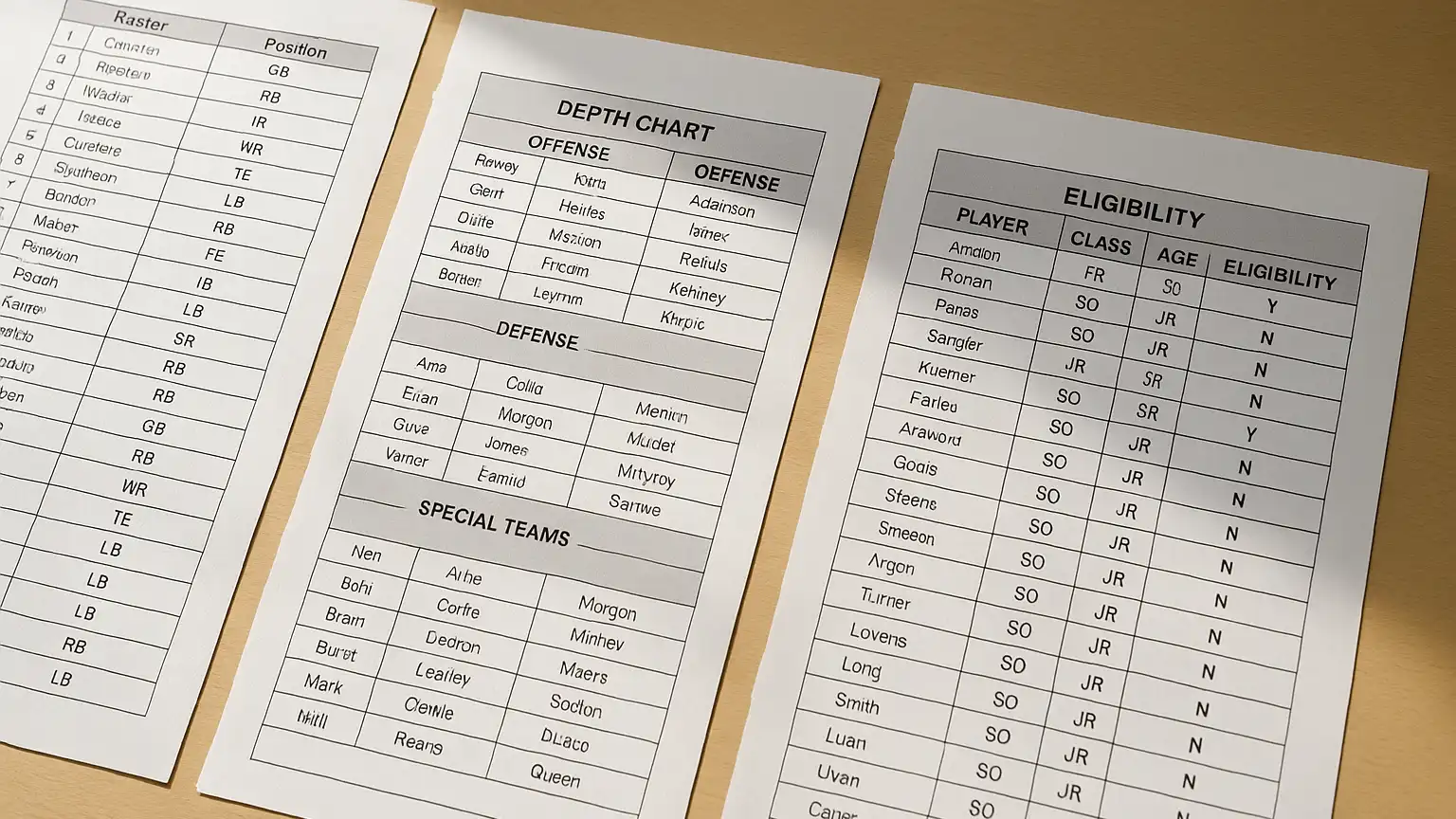
Playing time is not a feeling. It is arithmetic. Bodies, eligibility years, and scholarship counts. If a staff cannot walk you through the numbers at your position, either they have not done the math or they do not want you to.
Question 1: How many players are on the roster at my exact position right now, and what year is each one?
You want names and classes, not a general shrug. Four sophomores ahead of you at slot receiver is a real answer to plan around. So is one senior and a walk-on.
Red flag answer: "We don't really think in positions, we just find football players." That is a fine philosophy and a terrible answer to a roster question.
Question 2: How many players did you sign at my position in the last two classes?
This tells you the pace of the pipeline. A staff that signs three defensive tackles a year is going to keep signing three a year, no matter what they say about you being the guy.
Red flag answer: "I'd have to look that up." They know. They built the class.
Question 3: Who am I competing with in this same class, and are you still recruiting my position?
Programs recruit until the class closes. That is normal. What you want to know is whether you are the priority or the fallback. Ask directly and watch the pause.
Red flag answer: "You're our only guy" when their public commitment list already shows two players at your spot.
Question 4: In the last three years, when did true freshmen at my position actually see the field?
History beats promises. If nobody at your position has played before year three, that is the culture, and one conversation will not change it.
Red flag answer: "It depends on the kid." True, but incomplete. Push for names and snap counts. If the honest answer is that freshmen redshirt, a coach willing to say so out loud is telling you something valuable about how they operate.
- Write down every number they give you. Compare it to the roster page that night.
- Ask the same question at two schools. The gap in specificity is the real data.
- Count transfers in, not just signees. A portal addition at your position changes the math instantly.
The Coach Recruiting You May Not Be There
Players commit to position coaches. Position coaches move. That is not cynicism, it is the job market. The average assistant does not stay in one building for the length of a four year career, and the guy who loves your tape may be gone before your second spring.
Question 5: How long has my position coach been here, and what is his contract situation?
You are allowed to ask. A coach in year one on a one year deal is a very different bet than a coach in year six who has turned down jobs. Neither is disqualifying. Both are worth knowing.
Red flag answer: Deflection to the head coach's job security instead. You asked about the person who will coach you every day.
Question 6: If you leave, what happens to my scholarship and my role?
Ask the head coach this in front of your parents. The good answer is honest and slightly uncomfortable. It sounds like: the scholarship is with the school, the role depends on who replaces me, and here is how we protect the guys we recruited.
Red flag answer: "I'm not going anywhere." Every coach who has ever left said that first.
Question 7: What exactly do you see me doing in this scheme, and what happens to that job if the scheme changes?
This is the single most skipped question in recruiting. A 6 foot 3 tweener who is a perfect stand-up rush end in a 3-4 becomes a project in a 4-3. Ask what your second-best fit is. If there isn't one, you are betting your career on one coordinator staying employed.
Red flag answer: A long description of a role that only exists in the current playbook, with no answer for what happens next.
Question 8: Which player currently on the roster is the closest comparison to me?
This forces a coach to be concrete. If they name a starter, ask how that player was developed. If they name someone who never played, that is information too. And if they cannot name anyone, they may be recruiting a name rather than a fit, which is exactly what happens when evaluations lean on clipped highlights instead of scouts fast-forward your mixtape.
Coaches who evaluate well can describe your game back to you in detail. They will mention a snap from the third quarter of a game nobody watched. That level of specificity is the strongest signal in the entire process. It means they studied you, and people who study you tend to develop you.
- Ask your position coach for his own career path. Where has he been, how long, and where does he want to go?
- Ask who develops you if he leaves. Quality staffs have answers about their whole room.
- Ask what they would change about your technique first. Vague praise is a warning sign.

The Part Of The Deal That Outlasts The Game
Football ends for everybody. For most players it ends earlier than expected, and usually with a phone call or an MRI rather than a ceremony. The four questions below are about the part of the deal that survives that day.
Question 9: Who is my academic advisor, and can I meet them on this visit?
Not the athletic academic office in general. The actual human assigned to your major. A program that has this scheduled before you ask is a program with real support. A program that says "we'll set that up later" is telling you where it ranks.
Red flag answer: "All our guys graduate, don't worry about it." Ask for the graduation rate for your sport, by position group if they have it.
Question 10: What happens to my classes during the season, and are there majors I cannot take here as a football player?
This is the question that saves careers outside of football. Some labs, clinicals, and studio requirements do not bend around practice. Engineering, nursing, and architecture students hear this the hard way in year two, after they have already moved.
Red flag answer: "You can major in anything." Almost never fully true at a program with mandatory afternoon practice blocks.
Question 11: Put the full cost in writing. What is covered, what renews annually, and what is not covered?
Get the number after aid, not the sticker price. Ask about summer school, books, housing in the offseason, and what the family pays out of pocket. Ask what happens to the money after a career-ending injury.
Red flag answer: Any version of "we'll take care of you" without a document. Verbal math is not math.
Question 12: If football stopped tomorrow, what would you want me to still get out of being here?
This one is not a trap. It is a character test. The best coaches answer it fast and personally, often with a story about a former player who is now a teacher or a project manager. They stay in touch with those guys. They know their kids' names.
Red flag answer: Any answer that is really just another football answer. If a staff cannot picture you as anything but a player, they will not care much when you stop being one.
How To Handle The Answers You Get
Take notes in real time, then compare schools on paper within 48 hours while the details are fresh. Rank them on specificity, not enthusiasm. Enthusiasm is a skill coaches practice. Specificity is proof of homework.
- Talk to a current player without a staff member in the room. Ask what surprised him most.
- Call a player who left the program. His story is one-sided and still useful.
- Ask a high school or juco coach what he heard about the staff. The coaching world talks.
- Give yourself a week after the last visit. Nobody makes better decisions inside a countdown.
Pressure is the most common recruiting tactic there is. A deadline that appears out of nowhere, an offer that expires Friday, a coach who needs a yes tonight. Programs with real conviction about you will let you think. They also tend to keep tracking players they missed on, which is one reason front offices find starters nobody so often turns up guys who were overlooked in the first round of offers.
Twelve Questions, One Decision You Only Make Once
The pattern across all twelve is simple. Ask for numbers, names, dates, and documents. Coaches who have done the work will hand them over without hesitating, because the details are the reason they want you. Coaches who are filling a slot will get warm, get general, and steer the conversation back to how much they love your film. That contrast shows up within about ten minutes, and once you hear it, you cannot unhear it.
You do not need every answer to be perfect. Some of the best fits come with honest bad news, like a stacked depth chart or a coach who admits he may take another job someday. Honesty is the thing you are shopping for. Write your twelve questions on a card, keep it in your pocket, and ask every school the same list in the same order. By the time you sit down with the last one, you will know exactly what you are choosing, and you will be able to explain why to anyone who asks for the rest of your life.